CRA Gross Negligence Penalties
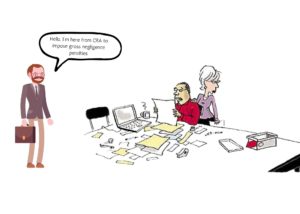
Gross Negligence Penalties
Once the Canada Revenue Agency (“CRA“) audits a taxpayer and comes to the conclusion that the taxpayer made false claims or under-reported their taxes, the CRA can apply additional penalties known as “gross negligence” penalties. The CRA imposes these penalties under subsection 163(2) of the Income Tax Act(“ITA”) and section 285 of the Excise Tax Act (“ETA”).
These penalties are the most severe penalties that the CRA can assess a taxpayer. For income tax, the gross negligence penalty will be 50% of the income tax that the CRA reassesses. For example, if the CRA reassesses a $40,000 tax owing, the gross negligence penalties will be $20,000. For GST/HST, the penalty will be 25%. For example, if the CRA reassesses a $40,000 GST/HST owing, the penalty will be $10,000. In addition, the CRA imposes interest on the gross negligence penalties and the amount of tax it reassesses.
What is “Gross Negligence”?
For the CRA to assess a gross negligence penalty to a taxpayer, they must establish that the taxpayer “knowingly or under circumstances amounting to gross negligence has made or has participated in, assented to or acquiesced in the making of, a false statement or an omission” on their tax return.
The term “gross negligence” is not defined in the Canadian tax statutes. The meaning of gross negligence has, however, been considered by the courts in various cases. In the case of Laplante v. R, the Tax Court of Canada provided a summary of principles regarding the meaning of “gross negligence.” The Court stated:
“Gross negligence” must be taken to involve greater neglect than simply a failure to use reasonable care. It must involve a high degree of negligence tantamount to intentional acting, an indifference as to whether the law is complied with or not.”
In determining whether the taxpayer’s conduct amounts to gross negligence, the CRA must contextually assess the taxpayer’s situation. While no one single factor will be determinative, the following are some of the factors that must be assessed in determining whether the taxpayer was grossly negligent:
- The magnitude of the omission in relation to the income declared
- The opportunity the taxpayer had to detect the error
- The taxpayer’s involvement in preparing the tax returns
- The taxpayer’s education and apparent intelligence
- The taxpayer’s genuine effort to comply with tax laws
Each factor must be assigned its proper weight in the context of the overall picture that emerges from the evidence.
Reliance on Accountants and Advisers
In some instances, the courts have held that the gross negligence penalties assessed by the CRA were not applicable as the taxpayer in question sought professional assistance. For example, in the case of MNR v. Donald Weeks, the taxpayer’s accountant prepared the taxpayer’s income tax return. The accountant claimed a $2,000 deduction for the support of the taxpayer’s wife even though the taxpayer’s wife was gainfully employed. The Federal Court held that the taxpayer was not subject to a gross negligence penalty as he was not privy to any gross negligence on the part of his accountant.
With that said, there have also been several cases where the courts have upheld the CRA’s imposition of gross negligence penalties despite taxpayers designating the responsibility for the mistake on their professional advisers who prepared the returns for them. However, most of these cases involved taxpayers who were “wilfully blind” to the actions of a tax preparer or tax advisor or cases where the taxpayers were very sophisticated in matters of business and tax. Wilful blindness is when a taxpayer has suspicions or reason to suspect wrongdoing but chooses to make further inquiries or ask further questions from the accountant or professional advisor.
Burden of Proof
Generally, in tax disputes with the CRA, the burden of proof is on the taxpayer to prove that their tax return is correct. As gross negligence penalties are very severe, the burden of proof for gross negligence penalties shifts to the CRA. This means that for gross negligence penalties, it is the CRA, and not the taxpayer, who must prove that the penalty is justified and appropriately applied. This onus is a heavy burden and is greater than the civil onus of balance of probabilities and closer to the criminal onus under the Criminal Code. This means that even if the CRA has any evidence to prove that the taxpayer was grossly negligent, if the evidence is not determinative, the taxpayer will be given the benefit of the doubt.
Professional Legal Help With the CRA
If the CRA has assessed you for gross negligence penalties, contact our firm immediately and book your free consultation. Our lawyers have the skills and experience necessary to give you the best chance of defending against gross negligence penalties and resolving your tax dispute.
—
By Kaveh Rezaei – Attorney at KR Law Firm
**Disclaimer
This article contains information of a general nature only and does not constitute legal advice. All legal matters have their own specific and unique facts and will differ from each other. If you have a specific legal question, it may be appropriate to seek the services of a lawyer.

