Application of General Anti-Avoidance Rule (GAAR) to Tax Planning
Understanding Tax Avoidance and Tax Evasion
It is a principle of tax law that taxpayers are entitled to arrange their affairs to minimize the amount of taxes they are required to pay. On this basis, the law differentiates between tax “evasion” and tax “avoidance.”
For a taxpayer’s actions to be considered tax “evasion,” the conduct must involve a deliberate violation of the tax laws. For example, a taxpayer commits tax evasion if they deliberately fail to report all taxable income or deduct made-up expenses on their tax returns. Tax evasion is illegal and is subject to prosecution under Canadian criminal laws. If you are interested in learning more about tax evasion, check out our blog post on tax evasion here.
Tax “avoidance” differs from tax evasion in that it does not involve the deliberate violation of the tax laws. Tax avoidance is essentially the ordering of one’s affairs (in accordance with the tax laws) in a way that minimizes the taxes that would otherwise be owed. Tax avoidance is merely concerned with minimizing tax, while tax evasion is about evading one’s legal liabilities. Tax avoidance will only be unlawful if it offends established judicial doctrines and statutory provisions such as the anti-avoidance rules.
Overview of Anti-Avoidance Rules
The Income Tax Act (“ITA”) contains provisions that disallow certain tax results sought by taxpayers through tax planning. These anti-avoidance rules are the “Specific Anti-Avoidance Rules” (“SAAR”) and the “General Anti-Avoidance Rule” (“GAAR“).
Specific Anti-Avoidance Rules (SAAR)
The SAARs counter specific types of avoidance transactions, such as stop-loss rules, anti-income shifting rules, capital gains and surplus stripping rules. The SAARs are intended to combat particular types of avoidance transactions. They, therefore, contain very technical and detailed language detailing the scope of the transactions that offend the ITA.
General Anti-Avoidance Rule (GAAR)
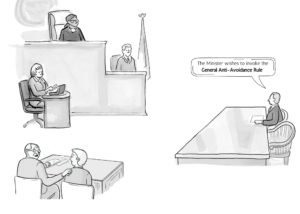
The GAAR is set out in section 245 of the ITA and was introduced into the ITA in 1988 and amended in 2005. The GAAR gives the Minister of National Revenue (“Minister”) statutory powers to combat abusive tax avoidance transactions.
Unlike the SAARs, the GAAR is intended to cover a broad range of tax avoidance transactions. The GAAR is a measure of last resort that the Minister can invoke in denying otherwise successful avoidance transactions which SAARs and other ITA provisions fail to catch.
So, for example, if a taxpayer arranges an avoidance transaction that works to avoid the application of the SAARs, the Minister may invoke the GAAR in order to deny the avoidance transaction. Therefore, the GAAR is only applicable to an avoidance transaction after all of the other provisions of the ITA, including SAARs, have been exhausted. Therefore,while the SAARs are drafted in a very technical and specific language, the GAAR is drafted broadly in order to be able to cover offensive tax avoidance transactions that would otherwise be permissible under a literal interpretation of the provisions of the ITA.
Minister’s Ability to Invoke GAAR
In the case of Lipson v. Canada, the Supreme Court of Canada stated that:
The GAAR is neither a penal provision nor a hammer to pound taxpayers into submission. It is designed, in the complex context of the ITA, to restrain abusive tax avoidance and to make sure that the fairness of the tax system is preserved.
In the case of Canada Trustco Mortgage Co. v Canada, the Supreme Court of Canada set out a three-part test for invoking the GAAR. The three-part test is as follows:
1. Is there a tax benefit arising from the transaction or series of transactions?
(The burden is on the taxpayer to refute this part of the test)
2. Is the transaction an avoidance transaction in the sense of not being arranged primarily for bona fide purposes other than to obtain the tax benefit?
(The burden is on the taxpayer to refute this part of the test)
3. Is the avoidance transaction that gives rise to the tax benefit abusive?
(“Abusive” in the sense that it cannot reasonably be concluded that the transaction resulting in the tax benefit is consistent with the object, spirit or purpose of the provisions relied upon by the taxpayer)
(The burden is on the Minister to establish this part of the test)
Tax Consequences of GAAR
The application of the GAAR to a tax planning transaction works to deny the tax benefit of the transaction. The consequence to the taxpayer is simply the loss of the tax benefit being sought. The application of the GAAR does not empower the Minister to impose any penalties (only interest on the taxes owing) and gives the Minister the power to assess the tax consequences to the taxpayer that are reasonable in the circumstances.
If the Canada Revenue Agency has assessed you under the GAAR, or if you want to know how the GAAR may impact your tax planning, contact our law firm today or book your free consultation.
—
By Kaveh Rezaei – Attorney at KR Law Firm
**Disclaimer
This article contains information of a general nature only and does not constitute legal advice. All legal matters have their own specific and unique facts and will differ from each other. If you have a specific legal question, it may be appropriate to seek the services of a lawyer.

